
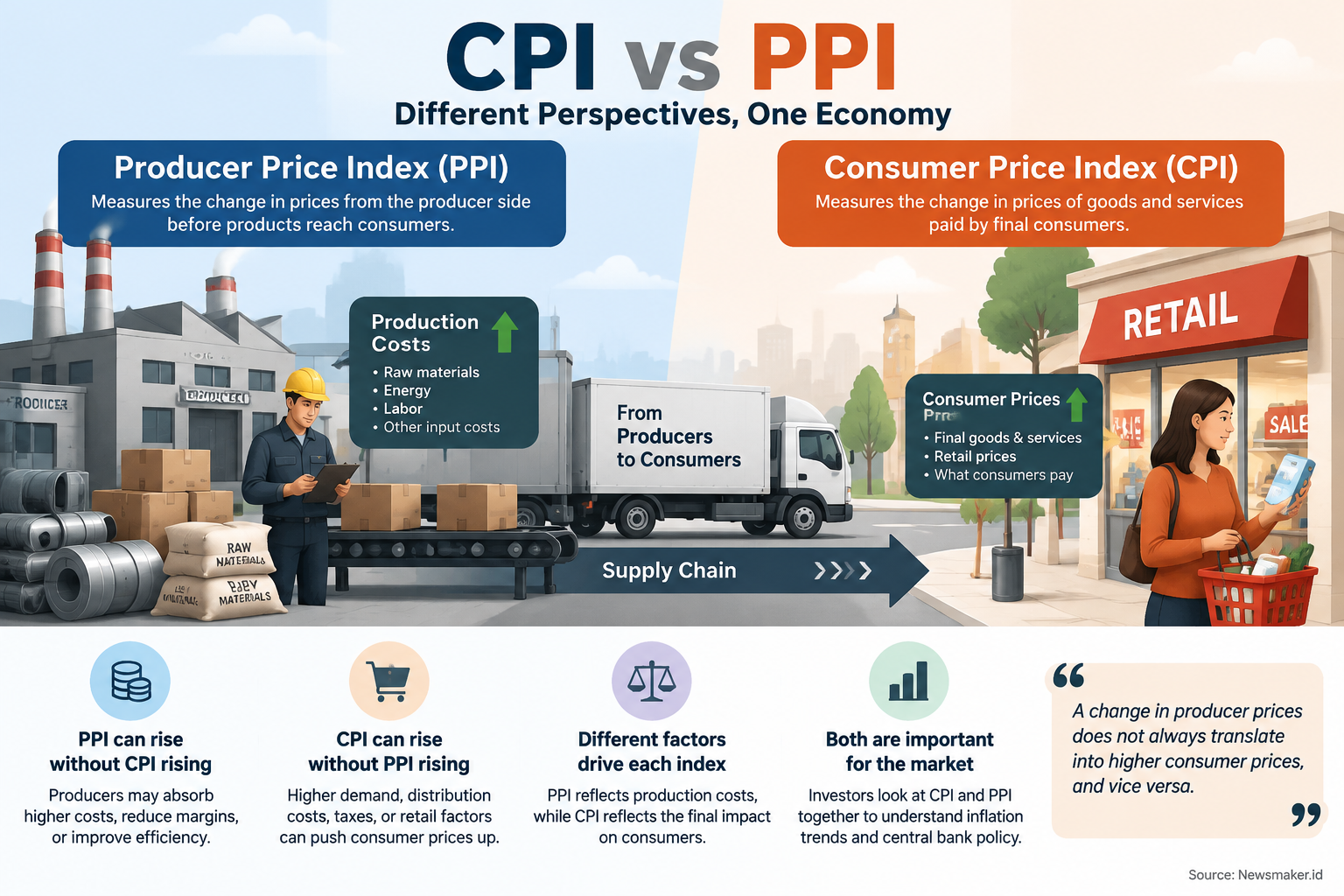
In economics, the Consumer Price Index (CPI) and Producer Price Index (PPI) are two important indicators closely monitored by investors to understand the direction of inflation. Both indicators measure changes in prices, but they represent different stages of the economy. CPI measures changes in the prices of goods and services paid by final consumers, while PPI measures changes in prices from the producer side before products reach consumers.
Simply put, PPI reflects price pressures at the beginning of the production chain, while CPI shows the final impact felt by households. When the prices of raw materials, energy, or production costs increase, these pressures are usually reflected first in PPI data. If producers face higher costs, they have several options, including raising selling prices, reducing profit margins, finding alternative suppliers, or improving production efficiency.
However, an increase in PPI does not always immediately lead to higher CPI. This is because producers are not always able to fully pass higher costs on to consumers. For example, when raw material prices increase, a food company may decide to hold its product prices steady because it is concerned that consumers will switch to competitors. In this situation, production costs rise, but consumer prices remain relatively stable as the company absorbs part of the pressure through lower profit margins.
Demand conditions also play an important role. If consumer purchasing power weakens, companies may find it difficult to raise prices even when production costs increase. Producers may face higher expenses but have limited ability to increase selling prices because consumers cannot accept higher costs. As a result, PPI can rise without being followed by a significant increase in CPI.
On the other hand, CPI can increase even when PPI does not show a major rise. This can happen due to factors beyond production costs, such as stronger consumer demand, higher distribution costs, tax changes, or disruptions in the retail supply chain. For example, the prices of certain goods or services can increase due to higher demand, even though the underlying production costs remain relatively stable.
Another example of PPI remaining stable while CPI rises can be seen in everyday goods such as clothing or electronic products. A clothing manufacturer may experience stable production costs, including fabric prices, labor expenses, and manufacturing processes, meaning producer prices remain unchanged. However, when consumer demand increases due to a popular fashion trend or seasonal shopping period, retailers may raise selling prices because products become highly sought after and inventory becomes limited. In this case, consumer prices (CPI) rise not because production costs increase, but because of demand factors and pricing strategies at the retail level, while producer prices (PPI) remain stable.
For financial markets, the relationship between CPI and PPI is closely watched because both indicators provide insight into the potential direction of central bank policy, including decisions from the Federal Reserve (Fed). If CPI continues to rise consistently, markets usually view it as a stronger inflation concern because higher prices are already being felt directly by consumers. Meanwhile, rising PPI is often considered an early signal of potential inflationary pressure, but markets still need confirmation on whether higher producer costs will eventually be passed on to consumers.
Therefore, investors do not only focus on whether CPI or PPI increases or decreases, but also examine the relationship between the two indicators. A rise in PPI does not necessarily mean consumer inflation will surge, and a rise in CPI is not always caused by higher production costs. Understanding the difference between these two indicators helps markets identify whether inflationary pressure comes from production costs, consumer demand, or other factors that could influence future monetary policy decisions.
Conclusion:
Higher PPI → CPI does not necessarily increase, because producers may absorb higher costs or choose to maintain selling prices.
Higher CPI → PPI does not necessarily increase, because consumer prices can rise due to demand, distribution factors, or other market conditions.
Investors usually analyze both CPI and PPI together to understand inflation trends and assess the potential direction of Federal Reserve interest rate policy.(mrv)
Source: Newsmaker.id